

The European Executive Research Agency (REA) has prepared an information package and series of Q&As below for how to apply or comply with Horizon Europe funding principles. This may help you to successfully navigate and implement your Horizon Europe project if your proposal is selected for EU funding.
Gender in R&I

Understanding how gender plays a vital role in research and innovation allows us to address the diverse needs of EU citizens. It enhances the societal relevance of the knowledge, technologies and innovations produced, and contributes to the production of greater goods and services.
Gender dimension versus gender balance
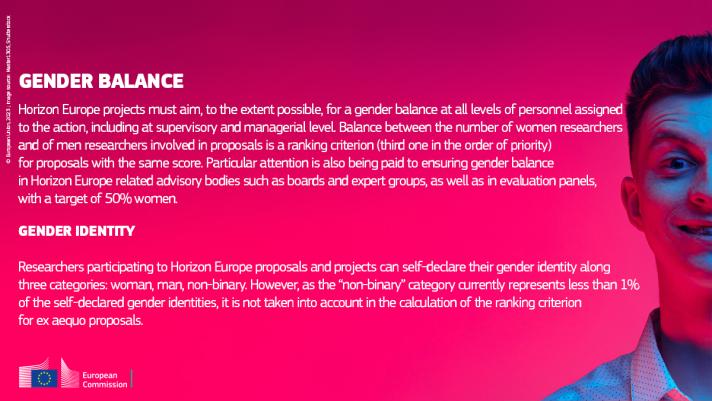
Gender balance is the balance between women and men in research teams who will implement a project. Horizon Europe projects should aim to have an even, 50/50 participation rate of both men and women amongst teams and in leading roles. In Horizon Europe, gender balance among researchers is a ranking criterion for proposals with the same evaluation scores.
The gender dimension implies analysing and taking into account the possible differences between men and women (biological characteristics as well as the social and cultural features), boys and girls, or males and females, in the R&I content of the project.
Integrating this gender dimension is now a mandatory requirement in all research and innovation projects across Horizon Europe, unless a topic explicitly specifies otherwise.
Gender equality provisions in Horizon Europe cover both of the afore-mentioned aspects, as well as in the Horizon Europe Programme Guide in the section dedicated to gender equality and inclusiveness.
Gender dimension in research projects

Sex
Refers to biological characteristics (including genetic, hormonal, physiological, anatomical) that distinguish between male, female, and intersex (in humans) or hermaphrodite (in non-human animals).
Gender
Refers to socio-cultural norms, identities and relations that, together, shape and sanction what are considered “feminine” and “masculine” behaviours, and structure societies and organisations.
Intersectionality
Factors such as racial or ethnic origin, age, socioeconomic status, sexual orientation, or disability, combine with sex and gender to shape a person’s or a group’s experience and social opportunities, thereby influencing the form of discrimination and inequality encountered.
In the R&I lifecycle, addressing sex and gender can appear challenging. However, examples in many fields show otherwise. For example, in pharmaceutical drug prescribing it can start with simple yet powerful steps, from including female and male cells, tissues and organisms throughout the testing process to reporting all data disaggregated by sex. These approaches can provide the knowledge needed to develop sex-specific dose adaptations of existing drugs, such as desmopressin or zolpidem, and may lead to gender-specific treatments in the future.
Researchers, physicians, pharmacists and patients should also consider gender differences in how symptoms are experienced and expressed. What is reported and how it is reported affect which diagnostic steps occur, and which medications are prescribed.
This example and many others can be found in the EU’s ‘Gendered innovations 2’ report.
Gender Equality Plans

With Horizon Europe, the Commission strengthened its commitment to gender equality by making the possession of a Gender Equality Plan (GEP) an eligibility criterion for all higher education establishments, research organisations, as well as public bodies from Member States and Associated Countries applying for the programme. To comply with the Horizon Europe GEP eligibility criterion, a GEP must meet four mandatory process-related requirements:
- Public document: The GEP must be a formal document published on the institution’s website, signed by the top management, and actively communicated within the institution.
- Dedicated resources: a GEP must have dedicated resources and expertise in gender equality to implement the plan.
- Data collection and monitoring: organisations must collect sex/ gender disaggregated data on personnel (and students, for the establishments concerned) with annual reporting based on indicators.
- Training: The GEP must also include awareness-raising and training actions on gender equality.
In addition to these four mandatory requirements, there are five recommended content-related (thematic) areas that organisations may wish to consider in their GEP:
- Work-life balance and organisational culture
- Gender balance in leadership and decision-making
- Gender equality in recruitment and career progression
- Integration of the gender dimension into research and teaching content
- Measures against gender-based violence, including sexual harassment
REA has an extensive portfolio of projects funded under the Horizon 2020 programme, supporting a critical mass of European universities, research centres and national authorities. These participating institutions became catalysts at ERA level for promoting the design and implementation of Gender Equality Plans, which now have become an eligibility criterion in Horizon Europe.